
Blog: Types, Grades and Applications
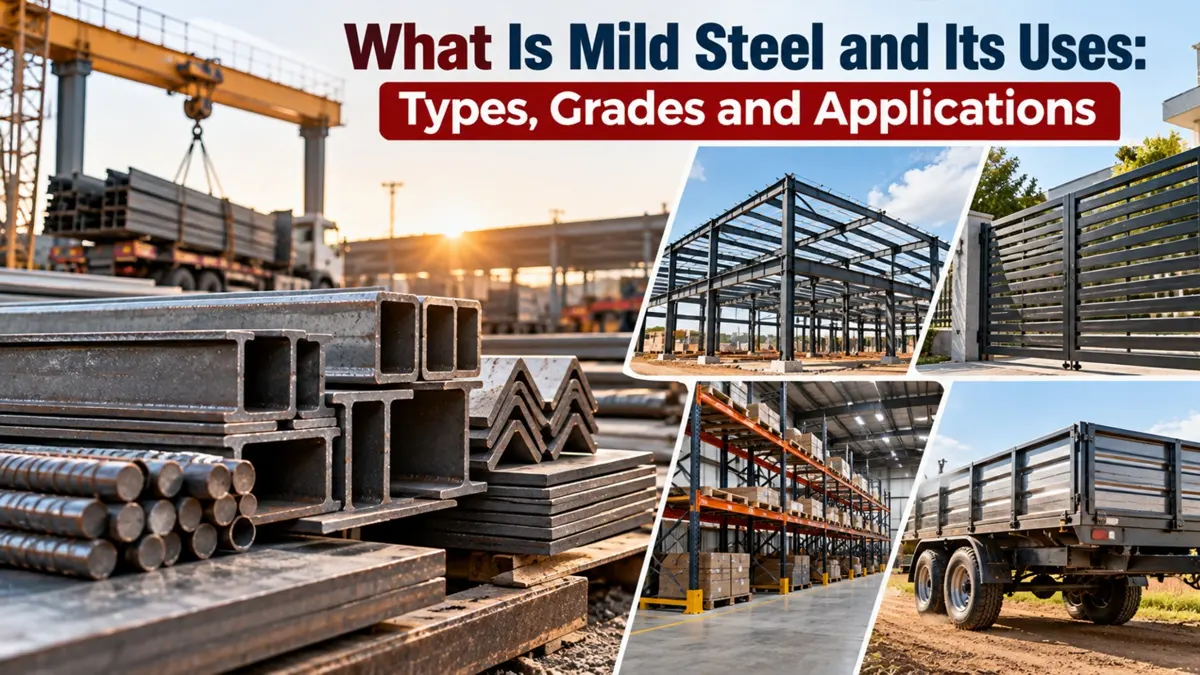
What Is Mild Steel and Its Uses: Types, Grades and Applications
The gate of your house, the shed of a factory, the racks in a warehouse and the frame of a tractor trolley are all likely to be made of the same metal: mild steel. It is the steel most fabricators and contractors use every day.
If you have ever wondered what is mild steel and its uses, this guide explains it in plain words. You will learn what mild steel is made of, its main types of mild steel, the grades used in India and where each MS product fits. We also compare mild steel vs other steel types like stainless steel (SS) and galvanised iron (GI), so you know when MS is the right choice and when it is not.
Explore Our Steel Buying Guides
How to Choose a Steel Supplier: A Practical Guide for Mild Steel Buyers
Bulk Steel Buying Tips for Contractors: How to Buy Structural Steel Without Overpaying
What Is Mild Steel and Its Uses: Types, Grades and Applications
What Is Mild Steel?
Mild steel is a low-carbon steel. It is mostly iron, with only about 0.05% to 0.25% carbon. This small amount of carbon makes it easy to cut, bend and weld, while keeping it strong enough for frames, sheds and structures. In the market, it is simply called MS.
The word "mild" tells you how it behaves. Adding more carbon makes steel harder, but also more brittle and difficult to weld. Mild steel stays on the softer side, which is why a welder can work with it easily on any site.
What is mild steel made of?
- Iron: about 98% or more, the main base metal
- Carbon: about 0.05% to 0.25%, gives strength
- Manganese: up to about 1.5%, adds toughness
- Silicon: a small amount, used while making the steel
- Sulphur and phosphorus: kept very low, because too much makes steel brittle
The exact limits depend on the grade. [VERIFY: check these ranges against the latest IS 2062]
How Is Mild Steel Made?
Mild steel is made by melting iron, removing most of the carbon and impurities, and then rolling the hot steel into shapes. Large steel plants do this in three main steps.
- Melting: iron ore or scrap is melted in a blast furnace, basic oxygen furnace or electric arc furnace.
- Refining: extra carbon and impurities are removed, and small amounts of manganese and silicon are added to reach the right grade.
- Casting and rolling: the liquid steel is cast into slabs or billets, then hot rolled into plates, coils, angles, channels, joists and bars.
Properties of Mild Steel
Mild steel is strong, flexible and easy to weld, which is why it suits most fabrication work. It is also magnetic and fully recyclable. Its weak point is rust: bare mild steel corrodes in rain and moisture, so it needs paint, primer or a zinc coating.
- Easy to weld: works well with arc, MIG and gas welding
- Bends without cracking: good for frames, rings and curved work
- Easy to machine: cuts, drills and grinds without much tool wear
- Good load strength: enough for sheds, platforms and most structures
- Magnetic: because it is mostly iron
- Rusts without protection: needs coating for outdoor use
Types of Mild Steel
The easiest way to understand the types of mild steel is to look at three things: its shape, its finish and its grade. When you place an order, you usually need all three, for example "MS angle, hot rolled, IS 2062 E250".
By shape
- Sections: angles, channels and joists (beams)
- Bars: flat bars, round bars and square bars
- Flat products: HR plates, HR coils, sheets and chequered plates
- Pipes: round pipes and square pipes
By finish
- Hot rolled (HR): rolled while hot; slightly rough, dark surface; used for most structural work
- Cold rolled (CR): rolled again at room temperature; smooth and more accurate; used for panels and furniture
- Galvanised (GI): mild steel with a zinc coating for better rust protection
By grade
In India, structural mild steel follows IS 2062. The number in each grade shows its minimum yield strength, which is the load at which steel starts to bend permanently.
| Grade | Min. yield strength | Used for |
|---|---|---|
| E250 | 250 MPa | Everyday fabrication, sheds, gates |
| E350 | 350 MPa | Heavier structures and machine bases |
| E410 | 410 MPa | Bridges and heavy engineering |
E250 is the grade most fabricators buy. [VERIFY: values are for thinner sections; confirm in the latest IS 2062]
Note: some websites call medium-carbon and high-carbon steel "types of mild steel". That is not right. Mild steel always means low-carbon steel. Medium and high-carbon steels are harder, separate types of carbon steel.
Uses of Mild Steel
The most common uses of mild steel are building frames, factory sheds, gates, grills, railings, staircases, machine frames, vehicle parts, racks and furniture. It is chosen for these jobs because it is affordable, easy to weld on site and available in almost every size.
Where it is used
- Construction: columns, beams, roof trusses, sheds and warehouses
- Fabrication shops: gates, grills, shutters, railings and staircases
- Factories: machine frames, base plates, guards and trolleys
- Automobile and transport: chassis parts, trailer frames and truck bodies
- Agriculture: tractor trolleys, farm tools and storage sheds
- Homes and offices: racks, almirahs, tables and shelves
Which MS product goes where
| MS product | Common jobs |
|---|---|
| Angle | Trusses, frames, racks, towers |
| Channel | Purlins, staircase stringers, trailer frames |
| Joist (beam) | Main beams, mezzanine floors |
| HR plate | Base plates, tanks, machine bases |
| Chequered plate | Steps, platforms, anti-slip floors |
| Square / round pipe | Gates, railings, sheds, scaffolding |
| Flat / round / square bar | Grills, brackets, shafts, gate designs |
| Welding rod | Joining and repairing MS parts |
Of all these, the angle is the most flexible section in a fabrication shop. The same size can become a frame, a support or a brace. If you are looking for mild steel angle in Ghaziabad, Mangaldeep Steels keeps angles in stock along with the rest of the MS range.
For load-bearing work, the section size should always come from your structural engineer. The list above only shows typical jobs.
Advantages and Disadvantages of Mild Steel
Mild steel is cheap, easy to work with and easy to find, which makes it the first choice for most structures. But it rusts without protection and is not as hard as high-carbon or alloy steel. Knowing both sides helps you use it in the right place.
Advantages
- Costs less than stainless and alloy steel
- Easy to weld, cut, drill and bend
- Available in many shapes and sizes
- Strong enough for most buildings and frames
- Easy to repair or modify later
- Fully recyclable
Disadvantages
- Rusts in rain and moisture if left bare
- Needs paint, primer or galvanising for outdoor use
- Lower strength than high-carbon and alloy steel
- Cannot be hardened much by heat treatment
- Not suitable for direct food contact
How to stop mild steel from rusting
- Clean the surface and apply a red oxide or zinc primer before painting
- Choose GI for parts that stay in the open or near water
- Keep stored steel off the ground and under a cover
- Touch up scratches and weld joints with paint quickly
Mild Steel vs Other Steel Types
The main difference in mild steel vs other steel types is what is added to the iron. Mild steel has very little carbon, so it is cheap and easy to weld. Stainless steel has chromium, so it resists rust. GI is mild steel with a zinc coat. High-carbon steel has more carbon, so it is harder but brittle.
In simple terms, steel comes in four main families: carbon steel (mild steel belongs here), alloy steel, stainless steel and tool steel.
| Steel | Rust resistance | Cost | Best for |
|---|---|---|---|
| Mild steel (MS) | Low | Low | Structures, gates, sheds |
| Stainless steel (SS) | High | High | Kitchens, food units, wet areas |
| Galvanised iron (GI) | Good | Medium | Roofing, outdoor pipes, fencing |
| High-carbon steel | Low | Medium | Tools, springs, cutting edges |
MS vs SS
Use MS when the job is structural, the budget matters and the steel will be painted. Use SS when rust, hygiene or a shiny finish matters, like in kitchens, hospitals or food plants. SS costs more because it contains chromium and nickel.
MS vs GI
GI is the same mild steel with a zinc layer on top. It lasts longer outdoors, so it suits roofing, fencing and open pipelines. Plain MS is better when the job needs a lot of welding, because welding burns away the zinc at the joint. If you weld GI, coat the joint with zinc paint.
Frequently Asked Questions
Need Mild Steel in Ghaziabad?
Now that you know what is mild steel and its uses, the next step is picking the right section, size and grade for your work. If you are not sure, share your job details with us and we will help you choose.
Mangaldeep Steels has 35 years as a steel supplier, with 8,000+ customers served and 5,000+ repeat clients. We are an authorised distributor of SAIL, JSW, Vizag Steel, APL Apollo, MSP and KVS. Our 20,000 sq. meter warehouse stocks pipes, bars, plates, sheets, coils, angles, channels, joists, chequered plates and welding rods, and overhead cranes help us load bulk orders fast.
Call us for today's rate, or contact Mangaldeep Steels in Ghaziabad. We deliver within Ghaziabad.
Mangaldeep Steels
C-74, Loha Mandi, Bulandshahr Road Industrial Area, Ghaziabad, Uttar Pradesh 201002
35 Years
Of steel supply experience